
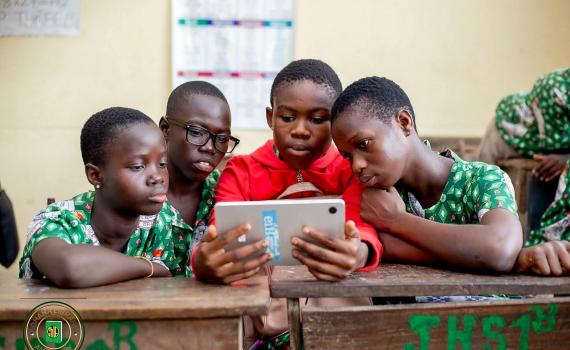
Computers and the internet have the potential to open up a world of educational and learning opportunities for school students. However, schools in Ghana face challenges in using digital technology: they have limited network connections, unreliable power and low numbers of devices. Some schools have no ICT infrastructure.
The ‘Digital learning @ Ghana public libraries’ project, implemented by EIFL and partners from September 2023 to May 2026, built the capacity of librarians at 15 regional and district public libraries that have internet connections and computers for public use to teach school students aged 12 - 18 digital and information literacy skills, and to introduce them to open online educational resources (OERs).
By the end of the project, the libraries had trained more than 19,800 students in outreach visits to 300 Junior and Senior High schools, and conducted in-depth digital learning workshops in libraries for over 2,300 students. The students learnt a wide range of skills: basic ICT, Microsoft Office, internet search, digital reading, online safety, coding, graphic design, and web development. To encourage active participation and practical learning, library staff used interactive and learner-centered methods such as hands-on exercises, Kahoot quizzes, gamification, group activities, roleplay, videos, and demonstrations.
The project was supported by the Internet Society Foundation through the Strengthening Communities, Improving Lives and Livelihoods (SCILLS) grants programme.
PROJECT PARTNERS
EIFL’s partners were -
- Ghana Library Authority (GhLA), the government agency mandated to establish, equip, maintain and manage public libraries in Ghana. In all, GhLA manages a network of 142 public libraries across the country.
- TechSoup, a non-profit international network of non-governmental organizations that provides nonprofits, libraries, and foundations with technology solutions and skills to improve lives.
TIMELINE
September 2023 - May 2026
ACTIVITIES
- Assessing the digital skills and learning needs of children and teachers;
- Training librarians and ICT staff from 15 regional and district public libraries to provide digital skills and information literacy training to children;
- Reaching out to schools and conducting short digital skills and information literacy classes with teachers and children;
- Organizing and facilitating digital learning workshops in libraries to provide more in-depth digital skills and information literacy training using selected open educational resources.
- Organizing partnership building events for Government officials and other stakeholders.
ACHIEVEMENTS
- Trained 30 public librarians and ICT coordinators from 15 regional and district public libraries in facilitation skills; how to facilitate information literacy and digital skills workshops, and how to find, customize and use OERs to train students. The training built confidence to facilitate practical, engaging, learner-centered activities that transcend traditional teaching methods. See Ghana training shifts library approaches to digital literacy skills programmes, blog by Ugne Lipeikaite, EIFL-PLIP Impact Manager, June 2024).
- Organized interlibrary exchange visits to ensure that libraries where capacity to engage in project activities had declined (through new staff appointments or staff rotation) could learn from libraries with more experience. See Exchange visits strengthen Ghana Public Libraries, blog by Ugne Lipeikaite, EIFL-PLIP Impact Manager, February 2025.
- Created a list of OERs for libraries to use in digital skills and information literacy training, and adapted interactive learning tools for online safety training for the Ghanaian context.
- Adapted resources include the Mission Viral game and two educational resources about misinformation and AI-generated content.
- The experience of adapting educational content was shared at a demonstration workshop during the eLearning Africa 2026 conference (5–6 June 2026). The workshop, titled 'Localising Open Educational Resources to Fight Misinformation in Ghana', was led by Nora Obeng, a library assistant at the GhLA. Nora’s work in helping children recognize and challenge misinformation was featured in the conference newsletter.
- By the end of the project (May 2026), library training had reached over 22,100 students, as follows -
- 30 librarians and ICT coordinators conducted 334 outreach visits to 300 Junior and Senior High Schools, engaging over 19,800 students in short classes on basic ICT, Microsoft Office, internet searching, digital reading, online safety, coding, graphic design and web development. See Libraries give tech learning a reboot in Ghana, blog by Ugne Lipeikaite, EIFL-PLIP Impact Manager, September 2024.)
- the15 libraries organized and concluded 63 library-based digital learning workshops (each workshop comprising several sessions spread over four to six weeks), helping 2,307 students to advance their digital skills and knowledge on the topics covered during short outreach visits to schools.
- Built students’ confidence and willingness to engage with technology. In a post-training survey of 517 digital learning workshop participants, 96% reported increased confidence in using the internet and digital devices. Teachers also observed positive changes in students’ engagement and motivation during ICT classes. See our interview with Angela Afua Boatemaa, headmistress at St Anthony’s R/C Junior High School in Ashanti, Ghana, in the EIFL Annual Report, 2024.)
- Demonstrated libraries’ contribution to digital inclusion of vulnerable groups. Eastern Regional Library conducted successful outreach classes for children at Koforidua School for the Deaf, teaching computer coding using Rangers Coding (a game designed to teach children computational thinking and programming concepts). Eastern Regional Library also conducted outreach visits to underserved and rural communities, such as Lakpa Primary School and Asifaw D/A Basic School, providing students with their first experiences with digital tools.
- Won recognition for libraries as trusted digital learning hubs, strengthening their partnerships and relationships with schools, teachers, parents and local education authorities.
“Before the project, we were running very low scale digital skills programmes, teaching basic skills limited to the school curriculum — Word, Excel, PowerPoint, how to type — in just a few schools. Now we are reaching out to more schools, with an expanded range of skills and knowledge." — Gifty Sey, Municipal Librarian, Effutu Libraries. Read the full story in the 2025 EIFL Annual Report.
- Expanded the range of library services and programmes. Drawing on experience gained through the project, several libraries introduced new programmes. For example, Eastern Regional Library organized a girls’ coding club called ‘She Codes’; Ashanti Regional Library launched an outreach campaign to help students prepare for the Basic Education Certificate Exam (which determines progress to secondary school) using online quizzes based on past exam questions; Central Regional Library introduced workshops focused on digital content creation for social media and responsible and effective use of Artificial Intelligence (AI) tools.
FURTHER INFORMATION
Contact: Ugne Lipeikaite, EIFL-PLIP Impact Manager: ugne @ eifl.net
EIFL’s previous work with public libraries in Ghana -


