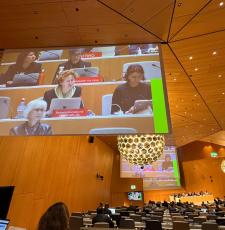
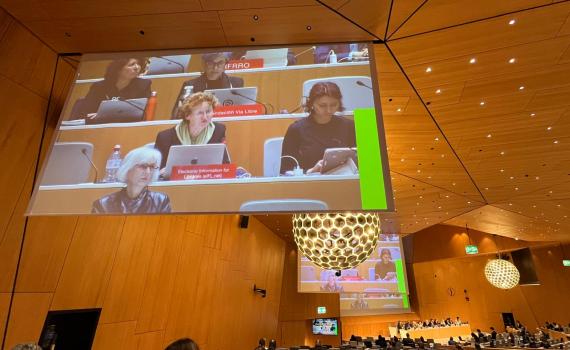
Teresa Hackett, EIFL Copyright and Libraries Programme Manager, joined members of the Access to Knowledge (A2K) Coalition at the latest session of WIPO’s copyright committee in Geneva from 18 - 22 May 2026, and reports on an important breakthrough on limitations and exceptions.
EIFL welcomes agreement by member states at WIPO’s Committee on Copyright and Related Rights (SCCR/48), that met in Geneva from 18 - 22 May 2026, to begin text-based work on limitations and exceptions (L&Es). For the next SCCR in December 2026, the Chair will prepare a text (in legal language) focused on three topics identified as priority areas: limitations and exceptions for preservation by cultural heritage institutions, people with other disabilities (meaning disabilities other than print disabilities covered by the Marrakesh Treaty), and education. The Chair’s text will draw on previous proposals by member states, including the African Group (SCCR/47/5), and the U.S. (SCCR/47/9 and 47/10), as well as the Chair and Vice-Chair (SCCR/47/8).
The breakthrough at this session came when all regional groups agreed to proceed with text-based discussions, while remaining open to the nature of any legal instrument that might eventually be achieved, such as a treaty, model law, or joint recommendation (these possible outcomes are set out in the 2012 Committee’s mandate, and the work programme adopted in 2023).
EIFL supports practical and effective measures to improve and implement L&Es in partner countries, in particular in regions where evidence shows that L&Es for libraries, education and research have fallen behind.
How global copyright rules can better serve people
South Africa’s Ambassador to WIPO and the WTO, H. E. Mzukisi Qobo, captured the issues in opening remarks at a side event organized by the Access to Knowledge (A2K) Coalition (EIFL is a founding member) titled ‘How global copyright rules can better serve people, creativity, and development’.
“I was a professor in my previous life. Academics, especially in the Global South, know the experience of publishing articles that we cannot assign to our students because our academic libraries cannot afford them. There are strict page-number and licensing restrictions that effectively limit how much knowledge students can access.
“Limitations and exceptions in this environment, therefore, cannot be an afterthought. Rather, they are integral to achieving the balance between the interests of creators and the broader public interest that copyright is ultimately meant to serve. And yet we find, in study after study, that developing countries often have the least permissive systems of public interest exceptions.”
At the side event, panelists from the library, archives and education sectors shared examples and experiences from their work in Africa, Asia-Pacific, and the Americas on the need for international action on L&Es. The President of the Association of Ibero-American National Libraries, and Director of the National Library of Chile, presented a powerful joint declaration on preservation and access signed by national libraries in 18 countries.
The slides from the side event are available here.
WIPO Toolkit on Access to Copyrighted Works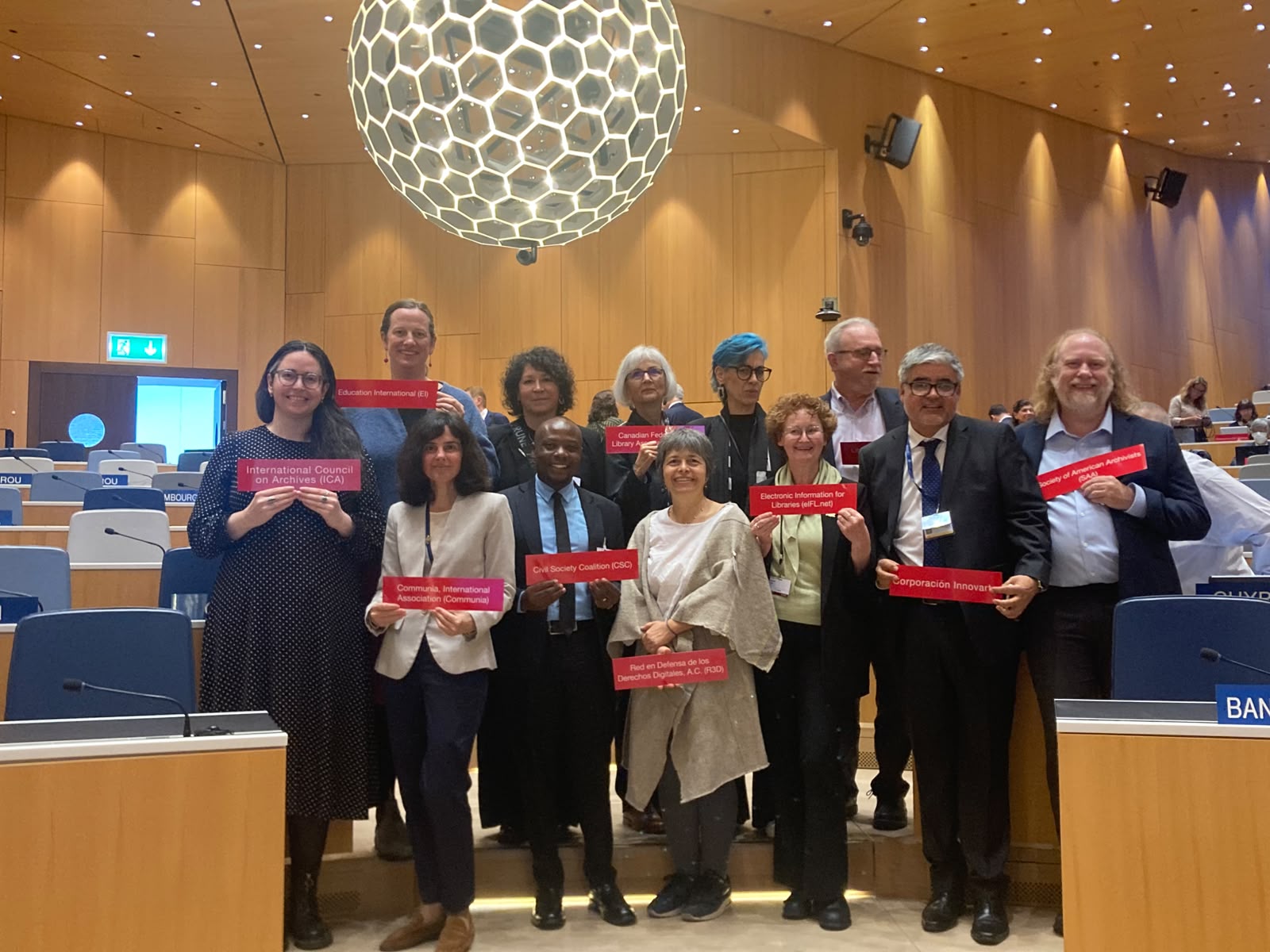
Access was the core theme of a presentation by the co-authors of a new WIPO Toolkit on Access to Copyrighted Works in the Collections of Cultural Heritage Institutions: Libraries, Archives and Museums (SCCR/48/5) - a companion to the 2024 WIPO Toolkit on Preservation. The toolkit on access sets out the role of libraries, archives and museums as trusted institutions with a public service mission and a responsibility to preserve and manage access to collections in accordance with legal, professional and ethical standards. It describes the purpose and importance of access, the dimensions of access, and solutions to providing access (including L&Es and licensing). It also provides useful guidance for policy-makers on how to construct a statutory provision for access. Delegations were invited to send any further comments to the WIPO Secretariat by June 1, 2026 after which the toolkit will be finalized.
A new way forward for the broadcast treaty
Member states also agreed on a new way forward to address outstanding points of contention in the broadcast treaty.
For the next SCCR, the Chair will prepare a new, stand-alone document with possible options in three areas that require further technical discussion. First, the connection between Article 11 on exceptions and limitations and Article 7 (Right of Fixation) and Article 8 (Protection of Signals used in making available to the public of stored programmes). In its statement, EIFL called for clarification of these articles: as currently drafted they affect access by libraries to the underlying broadcast content, and they risk restricting use of the material by public institutions for social, educational and public interest purposes, even when those uses are permitted by copyright.
The other areas to be addressed by the Chair are Article 10 (Other Adequate and Effective Protection) and its connection with Article 5 regarding national treatment and the reciprocity principle, and Article 3.6 concerning the ability of member states to exclude certain categories of broadcast organizations from the scope of the treaty.
If this new, focussed approach on the outstanding issues on broadcasting leads to agreement on the overall draft treaty text, and if parallel progress is made on L&Es, member states might arrive at a consensus on moving both of these long-standing agenda items forward.
Background
- Read statements by EIFL at SCCR/48.
- Read the Summary by the Chair at SCCR/48.
SHARE / PRINT


RECENT BLOGS