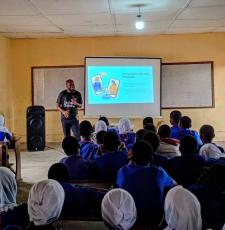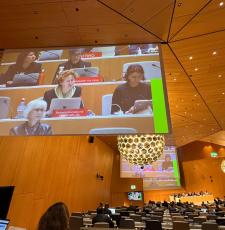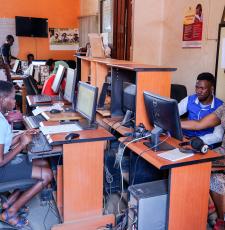

Ramune Petuchovaite, Manager of the EIFL Public Library Innovation Programme (EIFL-PLIP), shares case studies of successful public library advocacy with Universal Service and Access Funds in Ghana, Kenya and Uganda, and first steps taken in Malawi and Zambia.
A recent IFLA report (2026) on libraries and Universal Service and Access Funds (USAFs) features the successful collaboration between the National Library of Uganda (NLU) and the Uganda Communications Commission (UCC) in building public computing and connectivity infrastructure through local libraries. This made me look back at our work in advocating with USAFs in Ghana, Kenya and Uganda for resourcing of public libraries with digital technology for public access.
The IFLA report studied the work of USAFs in 66 countries and found that in 29 countries they have included libraries in their digital inclusion funding programmes. USAFs are financial mechanisms set up by governments to help expand telecommunications networks and services in rural, remote and underserved areas. Financed by levies on telecom operators, these funds subsidize essential communications services that are not commercially profitable. Governments do not naturally consider libraries to be partners in digital transformation programmes, so additional efforts are often needed to convince government officials about the role that public libraries can play in providing public access to computers and the internet, as well as digital and information literacy skills, in communities. This lack of recognition stems from the traditional perception of public libraries as places that provide access to books and learning spaces, and promote literacy and reading.
I would now like to share examples of how EIFL's digital initiatives with library partners in Africa and advocacy have gained recognition of libraries and established collaboration with USAFs.
The Uganda case: from a small pilot project to annual plans
In 2012, EIFL supported Gertrude Kayaga Mulindwa, the former director of NLU, and her Uganda Library Advocacy and Awareness Raising Group, to build a case for supporting the digital transformation of Uganda's public libraries and to establish a working relationship with the UCC. The UCC oversees the Uganda Communication Universal Service and Access Fund (UCUSAF) in order to promote digital inclusivity across the country.
The UCC agreed to support a small pilot project in 2018 that involved equipping three public and community libraries with computers and internet connections for public use. The pilot project, implemented in Pallisa Public Library in the Eastern Region, Hoima Public Library in the Western Region, and Nakaseke Community Library in the Central Region, was a success. The successful pilot led to the formal inclusion of public and community libraries in annual UCC public digital infrastructure development plans. You can read more about the transformation of Uganda's public and community libraries, and the efforts involved, in the feature story included in the EIFL 2024 Annual Report. In the 2025 budget, the UCC earmarked 30 more libraries to receive equipment packages comprising 10 computers, plus wireless internet, a printer, a scanner and a photocopier. And in the next five years, the UCC plans to enhance ICT infrastructure in approximately 100 public and community libraries.
While writing this blog, I coincidentally received a WhatsApp message from Gertrude who had just visited the village where the Bonna Baana Association Community Library is based. She shared the joyful news that the library had “recently received 12 computers and a router from UCC. The internet is provided by Airtel Uganda. Isn’t that wonderful!”
Uganda is not the only EIFL partner country in Africa where we have seen the government recognise the role of public libraries as partners in bridging the digital divide, opening up new learning and economic opportunities for citizens in the digital era.
The Ghana case: expanding a mobile library ICT education programme
From 2012 to 2019, EIFL supported four regional libraries in Ashanti, Upper East, Volta and Western regions, branches of the Ghana Library Authority (GhLA), to equip their mobile library vans with solar-powered laptops and wireless internet. The vans travelled weekly to rural schools and provided hands-on ICT classes to help students develop digital literacy skills. The four mobile libraries helped over 3,200 children pass the Basic Education Certificate Exam, which is crucial for progressing to secondary school.
Evidence of the project's impact, collected by the four regional libraries, was used by the GhLA to convince the Ghana Investment Fund for Electronic Communications (GIFEC), the government agency in charge of the Universal Service Fund (USF), to equip the remaining six mobile library vans operated by regional libraries with solar-powered laptops, thus expanding the mobile ICT classes to 10 regions.
Read more about this transformational journey, in the feature story 'Changing children’s lives in Ghana’, which is included in the EIFL 2019 Annual Report.
The Kenya case: all public libraries equipped and connected
Since 2010, EIFL worked closely with the Kenya National Library Service (KNLS) and its former director, Richard Attuti, to change public and government perceptions of public libraries primarily as places for books and study. This was achieved through advocacy, building the ICT capacity of public librarians, and supporting new technology-enabled services and programmes that address community needs, for example, in the areas of agriculture, small business development, education and health.
Consistent efforts and a well-thought-out strategy, supported by examples of the positive impact in communities of technology enabled public library services and programmes have led to a working relationship between KNLS and the Communication Agency of Kenya (CAK), formerly the Communications Commission of Kenya, and the launch of a pilot project to install eResource centres for the public in 10 KNLS branch libraries across the country. Impressed by the success of the pilot project, CAK agreed to equip the remaining 46 public libraries with computers and internet access in 2016. This has enabled KNLS to develop digital inclusion and skills programmes for communities across the country. Read more about this journey, and the kinds of services the libraries introduced, in the feature story 'Transforming Public Libraries in Kenya', which is included in the EIFL 2016 Annual Report:
Malawi and Zambia: first steps taken
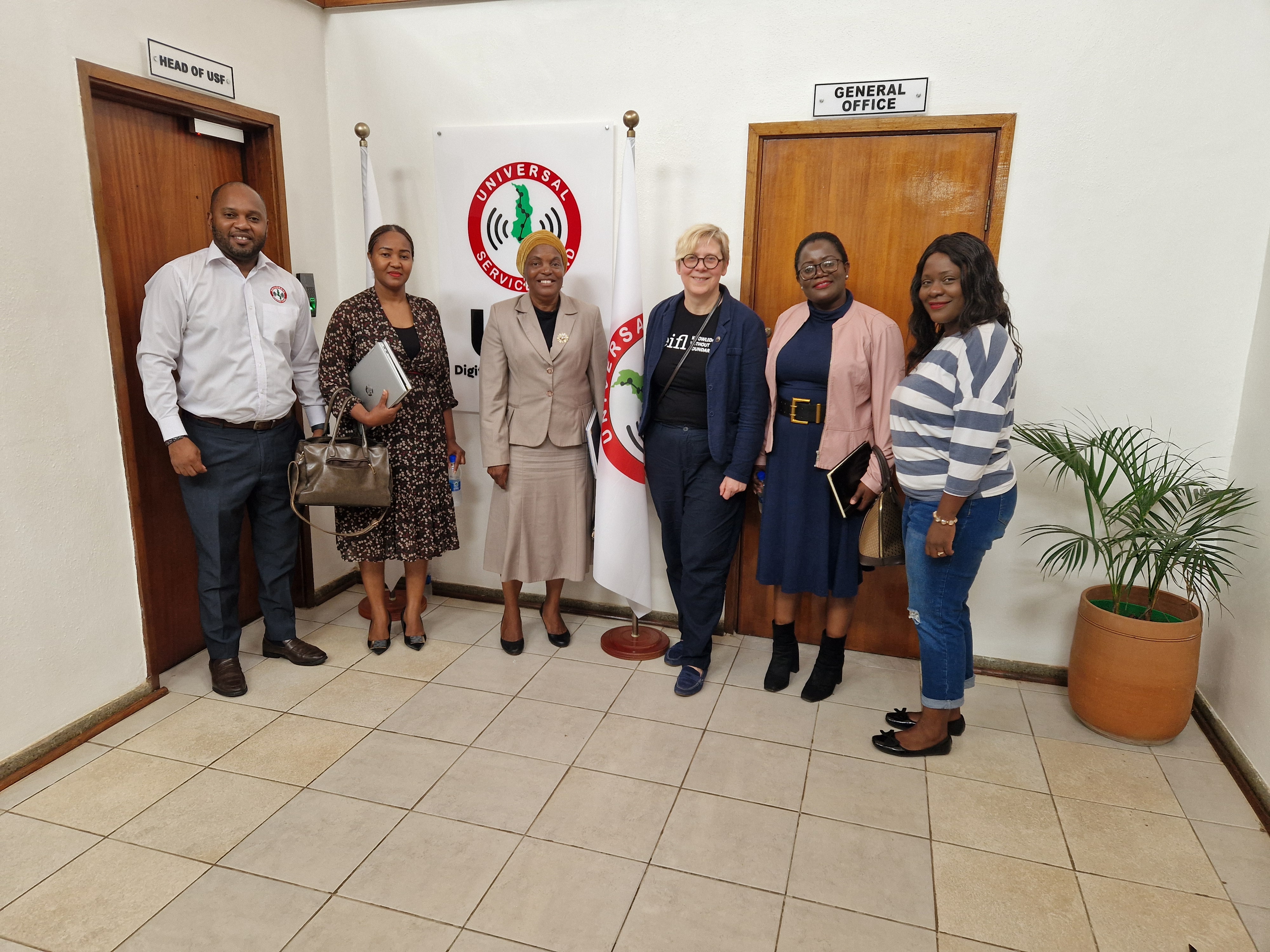
In 2024, I visited Malawi and Zambia to meet with the national library authorities to discuss our partnership with them in transforming public libraries. EIFL offered to develop skills of librarians to use digital technology effectively in services and we went to meet the government authorities to make the case for including public libraries in national ICT plans. I shared the cases of Kenya and Uganda with the Malawi Communications Regulatory Authority (MACRA) and the Zambia Information and Communications Technology Authority (ZICTA), both in charge of the national Universal Service Funds.
Following the meetings, the National Library Service of Malawi (NLS) and Zambia Library Services (ZLS) both developed and submitted concept papers to MACRA and ZICTA for the first time, outlining the potential of public libraries to contribute to digital transformation in Malawi and Zambia, and libraries’ digital infrastructure and connectivity needs. Although USAF funding in both countries could not accommodate libraries in their 2025 budgets, the doors are open for NLS and ZLS. There was some good news from Malawi, where the eGovernment Department of the Ministry of Information and Digitalisation responded to another NLS request for ICT infrastructure improvements, and has allocated 40 desktop computers to be distributed to 17 NLS branches in 2026. I am extremely proud of these library efforts and achievements.
Changing public and government perceptions of public libraries, and transforming libraries on a national scale to address community needs in the digital era, takes time and consistent work. It works in the end, the cases of Ghana, Kenya and Uganda are proof of that.
Call for libraries to seize the opportunity!
I hope the examples I have shared will inspire you to look into your country's USAF programmes and priorities. In addition, other public and private stakeholders could certainly be approached. These include government ministries responsible for digital transformation and infrastructure, as well as private telecommunications and banking companies, which often prioritise digital inclusion and literacy in their social responsibility programmes.
And here is one more resource I would like to share that includes some useful arguments and resources for your advocacy: 'What makes public access to ICT in libraries work?' (2023) blog by Ugne Lipeikaite, EIFL-PLIP Impact Manager, and myself.
SHARE / PRINT


RECENT BLOGS