
The Journal of Student Affairs in Africa (JSAA), a Diamond access journal, is the leading scholarly and professional platform for student affairs in African higher education. It amplifies diverse African voices, bridges theory and practice and contributes to the enhancement of student growth, wellbeing and success across the continent. The scope of the Journal is broadly defined as the staff and student experience of higher education in Africa with a specific focus on the professional practice of student affairs and research relevant to the African higher education context that may also have global impact and resonance.
Launched in 2013, the JSAA is published twice a year by its founders and owners, the JSAA Editors, in collaboration with the University of Pretoria (UP) in South Africa and the open access non-profit academic publisher, African Minds. The journal has Department of Higher Education and Training of South Africa accreditation, and is currently hosted by UP’s Faculty of Education.
A 13-month grant awarded by EIFL (October 2024 to November 2025) aimed to create a sustainable Diamond OA future for the journal.
“After over 10 years of successful operations, we needed to create a platform for renewal of the journal and its operations. This required training and inaugurating a new editorial team and journal manager, developing a comprehensive operational manual for the journal, agreeing a sustainability plan for the next 10 years and creating a vision and plan for the Community of Practice in Student Affairs in Africa Research,” says Dr Thierry Luescher, a Founding Editor of the Journal.
What has changed as a result of the project?
The Editorial Board and team have been renewed
Four new members of the Editorial Board, all senior professionals and/or scholars of Student Affairs, have been appointed and inducted, decreasing the workload of the Editorial Executive and the section editors.
The journal has a comprehensive operational manual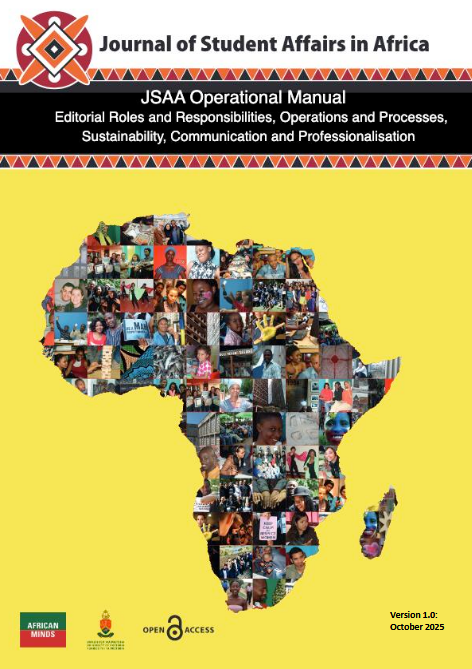
The JSAA Editorial Executive and editorial team members drafted and published a comprehensive Operational Manual for the JSAA that provides a comprehensive framework for the induction, capacity development, and day-to-day operation of all who contribute to JSAA.
The Operational Manual outlines functions, roles, and responsibilities across the Editorial Executive, Editorial Board, Sub-editors, Journal Manager, International Advisory Board, reviewers, technical team, and authors. It also documents the processes underpinning peer review, editorial decision-making, communication, and quality control.
By setting out these guidelines, the manual serves as a reference point for consistent practice, institutional memory, and transparency in how the journal is governed and managed, says Prof Birgit Schreiber, JSAA Executive Editor.
“The JSAA Operational Manual will inform all workshops with new editors as well as a Community of Practice / user-information session in 2026, and for years to come. It is a major achievement of this project.”
The JSAA has developed a financial sustainability plan
As part of the discussions towards creating greater financial sustainability for the journal and enhancing its impact, the Editorial Executive researched and developed an extensive JSAA Evidence of Impact Report (the first such report in 10 years). Knowledge generated fed into the new financial sustainability plan.
Over the last 10 years, the journal has been funded through institutional support, mainly institutions where the executive members are affiliated (for example, the University of the Western Cape, Stellenbosch University and UP); funded guest-edited issues; volunteer editorial work, and in-kind contributions such as server hosting and technical support that have helped offset operational costs.
The Editorial Executive and editorial team reviewed this model and reaffirmed their commitment to ensuring that the JSAA will remain a Diamond OA journal. They drafted a new financial sustainability plan (published in the Operational Manual) that envisages a mixed income strategy for the next 10 years.
This strategy includes additional, less traditional funding sources for the journal, such as community fundraising (for example, crowdfunding campaigns, installing a donations button on the website), applying for grants and entering award competitions, and revenue-generating activities, such as hosting academic workshops, conferences, or specialized training sessions.
The financial sustainability plan stresses the importance of strategic partnerships to extend JSAA’s visibility, broaden its resource base, and position it as a hub for collaborative scholarship on student affairs in Africa. The JSAA Editorial Executive will cultivate partnerships with universities, African research associations, philanthropic organizations, and international networks committed to open access and societal impact of knowledge. These collaborations may include co-funding special issues, co-hosting conferences, or contributing in-kind support such as training, editorial services, or technical expertise.
Conceptualisation of the JSAA Community of Practice
In 2023, just before the 10-year anniversary of JSAA, the JSAA Editorial Executive established a Community of Practice for Student Affairs in Africa Research (COP-SAAR), convening a network of active professionals in the field, which supports the journal’s sustainability by providing mentorship, professional development, webinars and virtual meetings, workshops and events.
During the project period, the JSAA Editorial Executive discussed ways of strengthening and expanding the COP-SAAR. The editors have participated in several workshops hosted by the Southern African Regional Universities Association (SARUA) and the Universities South Africa (USAf) association seminars and conferences. The COP-SAAR concept has further been extended into a vision and plan for the establishment of an ‘African Student Affairs Institute’.
Communications strategy to enhance the JSAA’s online presence and visibility
The JSAA has revised its communications strategy to include improved communications through the JSAA website; regular updates of all sites where JSAA is mirrored full-text or article metadata (currently, these are African Journals Online (AJOL), SciELO South Africa (Scientific Electronic Library Online), the Education Resources Information Center (ERIC) and the Directory of Open Access Journals (DOAJ). The JSAA Google Scholar profile will be monitored for citations, etc.
To improve social media communications JSAA has created and is testing a JSAA LInkedIn page to communicate with and build its professional network.
The JSAA has introduced a system of awards to celebrate excellence
The new JSAA Awards system (criteria and selection processes are described in the JSAA Operational Manual), aims to encourage and promote excellence in academic research and documentation in the field of student affairs in African higher education by celebrating impactful contributions from authors, JSAA editors and reviewers.
Recommendations for other Diamond OA journals
“We believe that the JSAA Operational Manual can serve as an excellent guide to any Diamond open access journal on what to consider in its conceptualisation and operations; it also illustrates with some consideration of alternatives, how JSAA - as a particular journal operating in a resource-constraint context and a historically underdeveloped and overlooked area of African higher education, theory and practice – has been able to overcome its challenges,” says Prof Birgit Schreiber.
What’s next for the JSAA?
The JSAA has several plans for 2026. These include publication of at least two issues (“perhaps three now that there are more editors”, says Prof. Teboho Moja, Editor-in-Chief of JSAA); planning and holding workshops and seminars with the JSAA COP-SAAR in collaboration with UP, and the launch of the JSAA Award System; the negotiation of a new five year Memorandum of Understanding (MOU) with the University of Pretoria as host institution, and fundraising, including launching a donation button on the JSAA website and trying out a round of ‘crowd-funding’ methods.
“Since its founding in 2013, JSAA has transformed a historically underdeveloped and overlooked area of African higher education: student affairs and services. The JSAA has grown into a pan-African platform for professional development, research and knowledge exchange, and policy dialogue. Through a combination of professional development, scholarly publishing, community building, and policy engagement, it is continuing to actively shape more equitable, inclusive, and effective higher education systems in Africa.
“The EIFL grant and project have made a huge difference in that it has both been an enabler and catalyst for change at the journal,” says Prof Teboho Moja.
The grant was awarded through the ‘Collaboration for sustainable open access publishing in Africa' project (November 2023 to October 2026) that aims to strengthen no-fee open access publishing in Africa, implemented by EIFL, AJOL (African Journals Online) and WACREN (the West and Central African Research and Education Network), with funding from Wellcome.
OA-AFRICA-GRANTEE


